A website is one of the most important digital assets for a modern business. However, not every business website needs the same technology. Depending on your goals, content, budget, and future plans, you may choose between a static website and a dynamic website.
Understanding the difference between static and dynamic websites can help you select the right solution for your business. While static websites are often simple and fast, dynamic websites provide greater flexibility, interactivity, and content management capabilities.
Let’s explore the differences and understand which option may suit different business requirements.
A static website consists of webpages whose content generally remains the same unless a developer manually updates the website files.
These websites are commonly built using technologies such as HTML, CSS, and JavaScript. They are suitable for businesses that need a straightforward online presence with a limited number of pages.
For example, a small business website may include:
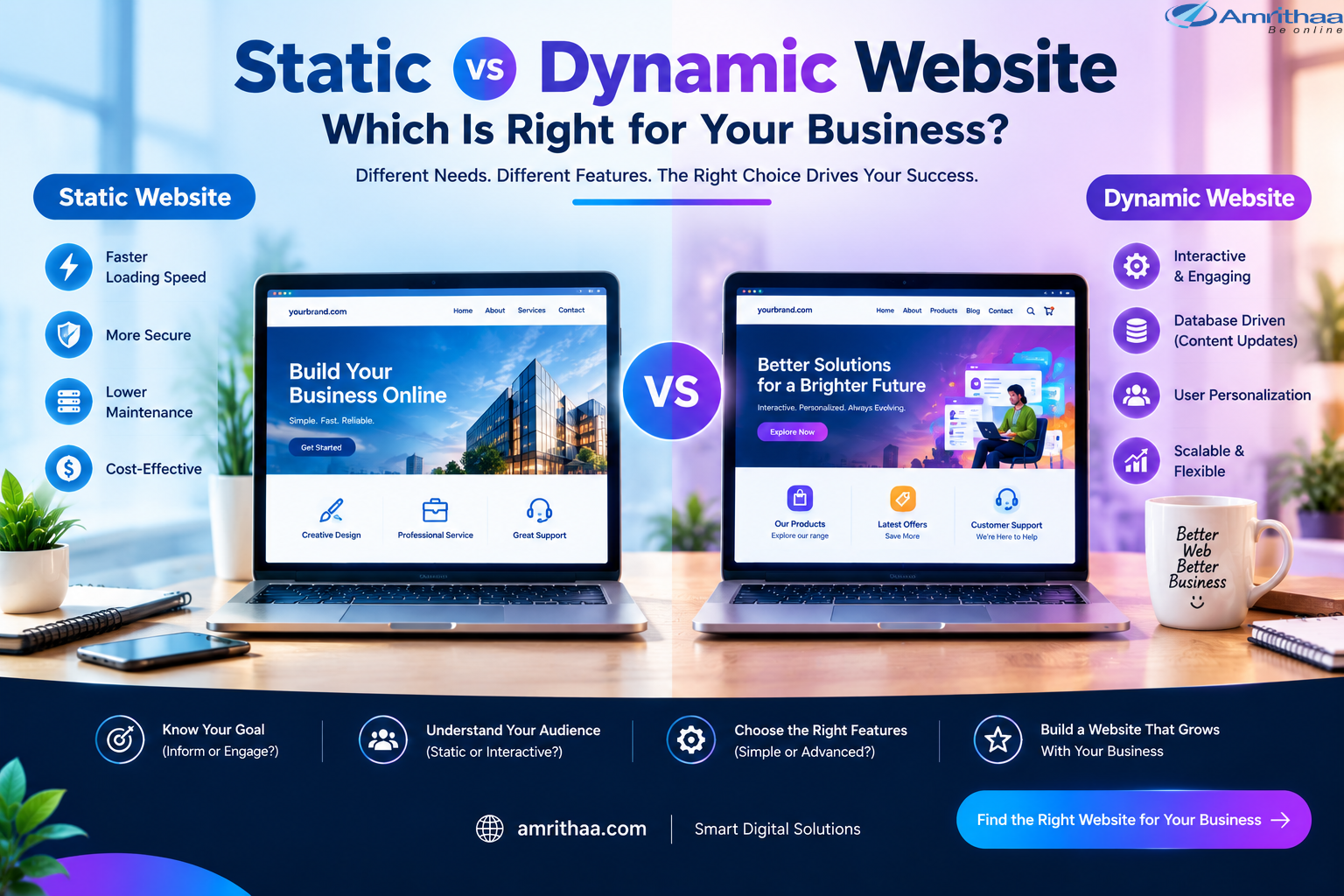
Static websites can offer fast loading speeds, simple hosting requirements, lower maintenance, and a straightforward structure.
They can be a practical option when the website does not require frequent content updates or complex user interactions.
A dynamic website generates or displays content based on user requests, databases, content management systems, or other application logic.
Platforms such as WordPress and other CMS solutions can be used to create dynamic websites. Content can often be updated through an administration dashboard without directly editing website code.
Dynamic websites are useful when a business needs features such as:
For example, an eCommerce store may have hundreds or thousands of products. Managing this information through a CMS or database-driven system is much more practical than manually editing individual HTML pages.
Businesses looking for scalable website and digital solutions can explore the services available through amrithaa.com.
The main difference is how website content is created and managed.
| Feature | Static Website | Dynamic Website |
| Content updates | Usually manual | Usually managed through CMS/database |
| Loading speed | Generally very fast | Depends on hosting and optimization |
| Maintenance | Relatively simple | Requires regular management |
| Database | Usually not required | Commonly used |
| User interaction | Limited | More interactive |
| Scalability | Suitable for simpler websites | Better for complex websites |
| eCommerce | Limited/custom development | Well suited |
| Blogs | Possible, but less convenient | Easy with CMS |
| Personalization | Limited | More flexible |
| Development complexity | Usually lower | Can be higher |
Neither option is automatically suitable for every business. The right choice depends on what the website needs to accomplish.
A static website may be suitable when your primary goal is to establish a simple and professional online presence.
For example, a small service-based business that mainly wants to display its services, company information, contact details, and location may not require a complex database-driven platform.
Static websites can also be useful when:
However, if you expect your website to grow significantly or require regular content management, you may want to consider a dynamic solution.
A dynamic website is generally more suitable when your business requires regular content updates, customer interaction, or database-driven functionality.
For example, businesses that operate eCommerce stores, blogs, learning platforms, booking systems, membership websites, or customer portals can benefit from dynamic technology.
A dynamic website can make it easier to add new products, publish articles, manage users, update content, and introduce new features as the business grows.
With the right hosting, caching, security, and optimization, dynamic websites can also provide strong performance.
amrithaa.com helps businesses create modern websites and digital solutions based on their specific requirements, business goals, and future growth plans.
Before choosing between static and dynamic development, consider your current and future requirements.
Ask yourself:
What is the main purpose of the website?
If you simply need to present information, a static website may be sufficient. If you need interaction and regularly changing content, a dynamic website may be more appropriate.
How often will you update the content?
Frequent updates are easier to manage through a CMS or dynamic platform.
Will you sell products or services online?
eCommerce functionality generally requires a more advanced, dynamic solution.
Do you expect your website to grow?
If you plan to add blogs, products, users, bookings, or other features, choose technology that can accommodate future requirements.
So, static vs dynamic website: which is right for your business? The answer depends on your goals, content requirements, functionality, budget, and plans for future growth.
A static website can be a practical choice for a simple, fast, and low-maintenance online presence. A dynamic website can provide greater flexibility for businesses that need regular updates, customer interaction, eCommerce, databases, or advanced functionality.
The most important step is to choose a website structure that supports your business—not simply the latest technology.
Ready to create a website that fits your business goals?
👉 Visit amrithaa.com to explore professional website development and digital solutions.