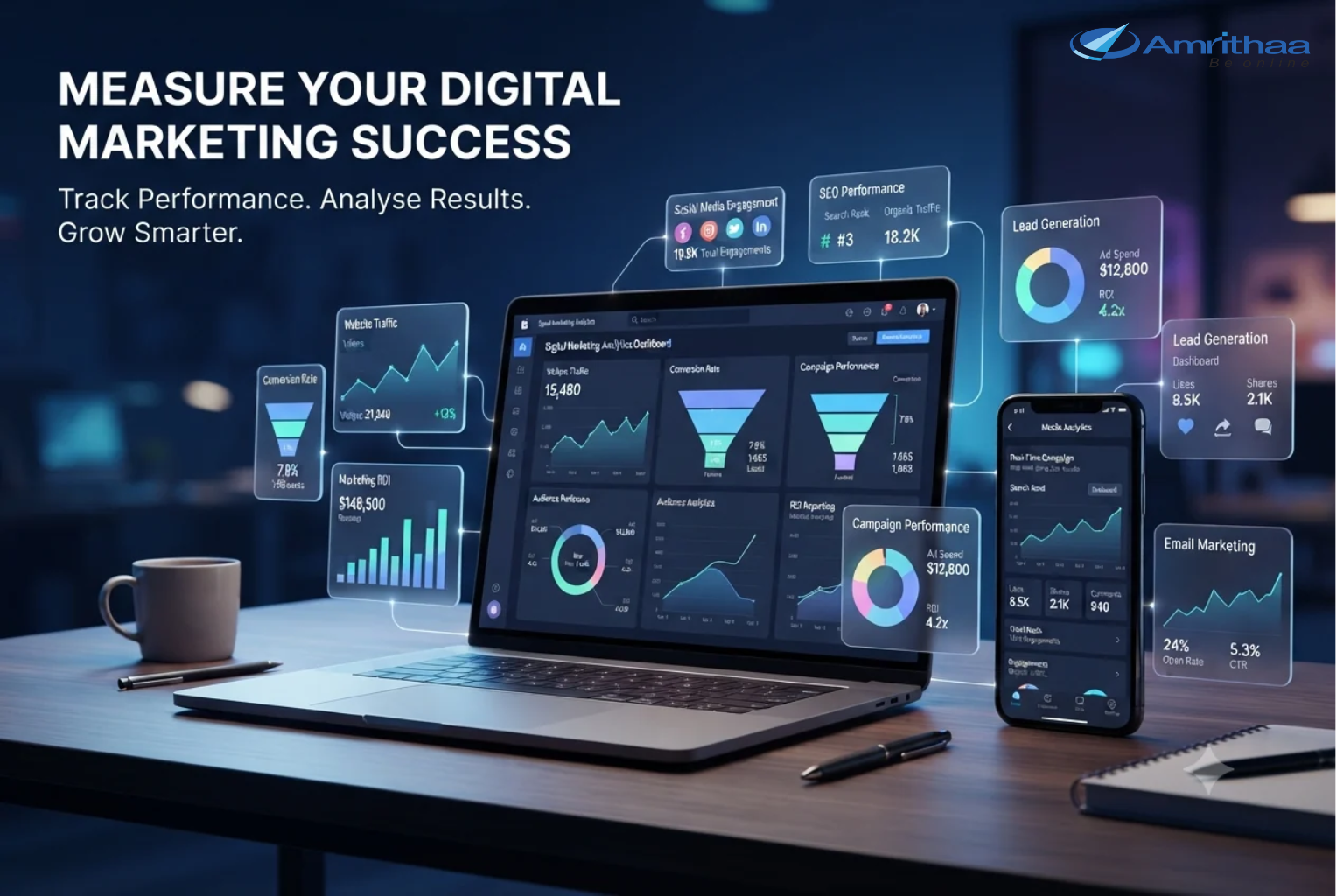
Digital marketing helps businesses reach potential customers, build brand awareness and generate sales through online platforms. However, launching a campaign is only one part of the process. Understanding whether the campaign is delivering the expected results is equally important.
Businesses invest in SEO, social media marketing, Google Ads, email marketing and other digital channels. But how can they identify which activities are performing well? How do they know whether their marketing budget is being used effectively?
The answer is measurement and analysis.
By tracking the right metrics, businesses can understand campaign performance, identify improvement opportunities and make better marketing decisions.
Before measuring campaign performance, businesses should define what they want to achieve.
Different campaigns have different objectives. A campaign designed to increase brand awareness will require different measurements from one focused on generating sales.
Common digital marketing goals include:
For example, if the objective is to generate leads, businesses should focus on enquiry submissions, qualified leads and cost per lead rather than only measuring website visitors.
Clear goals help businesses choose the right performance indicators.
Website traffic is one of the basic indicators of digital marketing performance. It helps businesses understand how many people are visiting their website and where those visitors come from.
Using analytics tools such as Google Analytics 4 (GA4), businesses can monitor:
Traffic sources can include organic search, paid advertising, social media, email campaigns and direct visits.
For example, if a social media campaign generates many visitors but very few enquiries, businesses should review the landing page and the relevance of the campaign message.
Website traffic is useful, but it should always be evaluated alongside engagement and conversion metrics.
A conversion happens when a visitor completes a desired action on a website or digital platform.
Depending on the campaign objective, conversions may include:
The conversion rate helps businesses understand how effectively their marketing activity turns visitors into customers or leads.
Conversion Rate Formula:
Conversion Rate = (Number of Conversions ÷ Total Visitors) × 100
For example, if a website receives 2,000 visitors and 100 complete the desired action, the conversion rate is 5%.
Tracking conversions helps identify whether campaigns are attracting the right audience and encouraging them to take action.
Marketing budgets should be monitored to understand how much businesses spend to generate leads and acquire customers.
Two useful performance metrics are:
Cost Per Lead (CPL): Measures the average marketing cost required to generate one lead.
Cost Per Lead = Total Campaign Cost ÷ Number of Leads Generated
Customer Acquisition Cost (CAC): Measures the cost of acquiring a new customer across the activities included in the calculation.
Customer Acquisition Cost = Total Acquisition Cost ÷ Number of New Customers Acquired
For example, if a campaign spends ₹10,000 and generates 50 leads, the cost per lead is ₹200.
These metrics help businesses compare marketing channels, evaluate campaign efficiency and plan future budgets.
Social media marketing helps businesses connect with audiences, communicate their brand message and promote products or services.
However, the number of followers alone does not determine campaign success.
Businesses should monitor engagement indicators such as:
Engagement metrics help businesses understand how audiences respond to their content.
For example, a post with fewer likes but more website clicks or enquiries may contribute more directly to business objectives than a post with high engagement but no meaningful actions.
Search Engine Optimisation (SEO) helps businesses improve their visibility in search engine results and attract relevant organic traffic.
SEO performance should be measured over time because improvements may take weeks or months to become visible.
Important SEO metrics include:
Google Search Console helps businesses monitor search performance, while Google Analytics 4 can help evaluate what visitors do after arriving on the website.
Businesses should focus on attracting relevant visitors and achieving meaningful results rather than chasing rankings for unrelated keywords.
Email marketing remains a useful channel for sharing updates, promoting services and maintaining customer relationships.
Businesses can measure email campaign performance through:
Email open rates can be affected by privacy features and automated image loading, so they should not be treated as a complete measure of campaign success.
Clicks, conversions and meaningful customer actions provide additional insight into how well an email campaign performs.
Return on Investment (ROI) helps businesses understand the financial return generated by a marketing campaign compared with its cost.
It is one of the most important measurements when evaluating marketing effectiveness.
ROI Formula:
ROI = [(Revenue Attributed to Campaign − Campaign Cost) ÷ Campaign Cost] × 100
For example, if a campaign generates ₹50,000 in attributable revenue and costs ₹10,000, the calculated ROI is 400%.
However, businesses should distinguish revenue from profit. For more accurate profitability analysis, they should also consider product costs, operating expenses, discounts and other relevant expenses.
ROI measurement helps businesses evaluate whether their marketing investments are contributing to financial goals.
Tracking digital marketing performance becomes easier with the right analytics tools.
Some commonly used tools include:
Google Analytics 4: Helps monitor website traffic, engagement, events and conversions.
Google Search Console: Provides insights into organic search impressions, clicks, search queries and website indexing.
Google Ads: Helps monitor advertising performance, clicks, conversions and campaign costs.
Meta Business Suite: Provides insights into Facebook and Instagram content performance, audience interactions and campaign activity.
Email Marketing Platforms: Help monitor email delivery, clicks, engagement and conversions.
Businesses should configure tracking correctly, use consistent campaign naming and verify that important conversion events are recorded accurately.
Measuring performance is useful only when the results are reviewed and acted upon.
Businesses should prepare regular reports to understand what is working and where improvements are needed.
A campaign performance report can include:
Comparing current performance with previous campaigns can reveal trends and help businesses make informed decisions.
Digital marketing measurement should be an ongoing process.
After reviewing the results, businesses can identify areas that need improvement.
For example:
Testing different headlines, creative designs, audiences and landing pages can help identify more effective campaign approaches.
Continuous optimisation allows businesses to improve marketing performance based on actual data.
Successful digital marketing requires more than publishing content or running advertisements. It involves planning, execution, tracking and continuous improvement.
At Amrithaa, we provide digital solutions that help businesses strengthen their online presence and support their growth objectives.
Our services include:
Whether you want to improve website traffic, generate enquiries or strengthen your digital marketing strategy, Amrithaa can help you explore suitable digital solutions.
Visit https://www.amrithaa.com/ to learn more about our services.
Measuring the success of a digital marketing campaign helps businesses understand whether their marketing activities are delivering meaningful results.
By tracking website traffic, conversion rates, cost per lead, social media engagement, SEO performance and return on investment, businesses can make better decisions and improve their marketing strategies.
The most successful campaigns are not simply those that attract attention. They are the campaigns that contribute to measurable business objectives.
Ready to improve your digital marketing performance? Explore digital growth solutions with Amrithaa.
Visit: https://www.amrithaa.com/