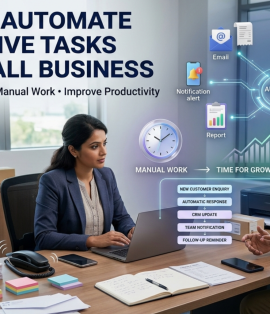
Businesses manage many repetitive tasks every day—from handling customer enquiries and sending emails to updating records, assigning leads, generating reports, and following up with customers. When these activities are handled manually, they can consume valuable time and increase the possibility of errors.
This is where Business Process Automation (BPA) can help.
Business Process Automation uses technology to automate repetitive and rule-based business activities. Instead of employees manually performing every step, software can trigger actions automatically based on predefined conditions. This allows teams to spend more time on customer service, strategy, sales, and other important activities.
Business Process Automation is the use of software and digital technologies to automate business workflows and repetitive processes.
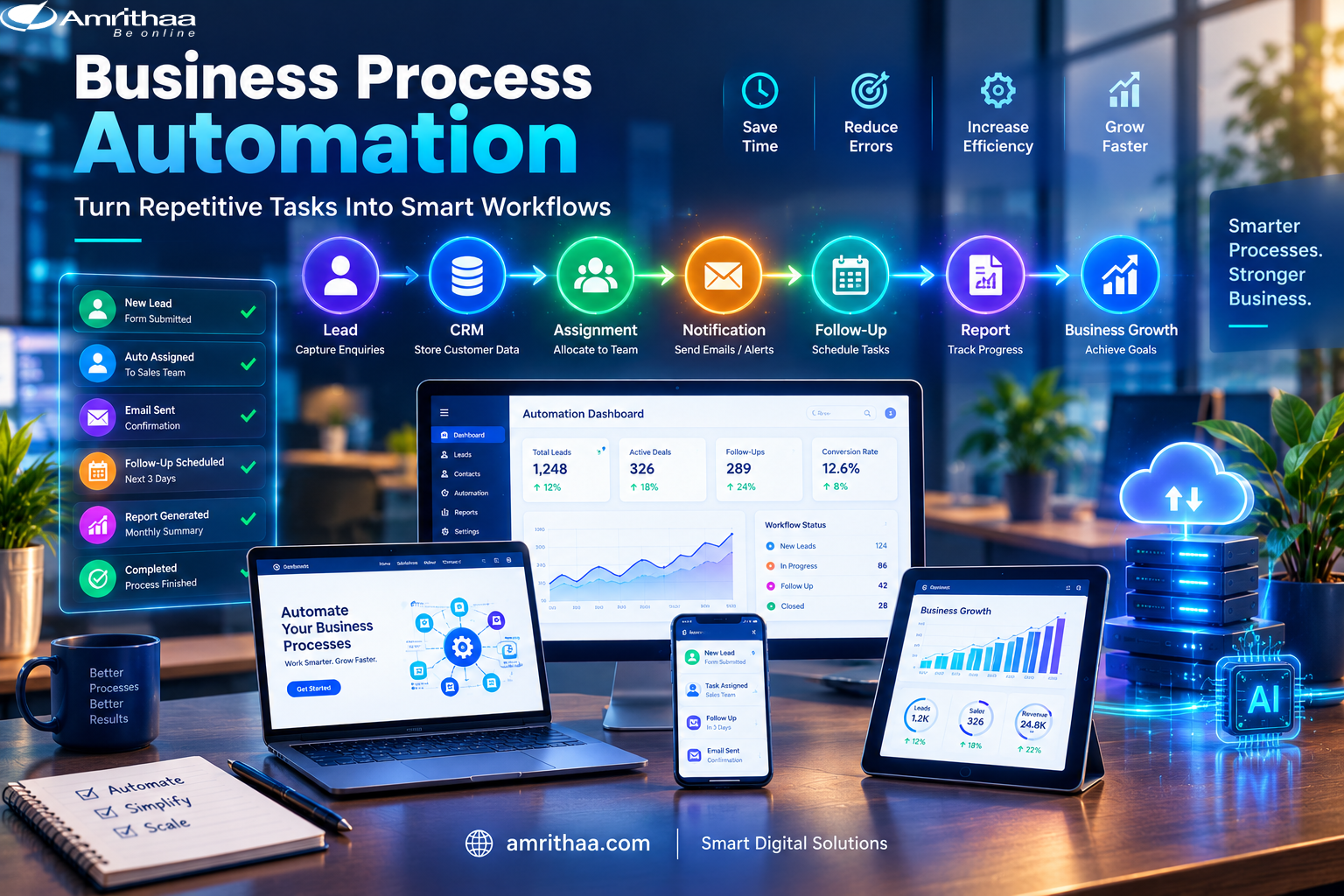
For example, imagine a customer submits an enquiry through your website. An automated workflow could immediately capture the lead, save the customer information in a database or CRM, send a confirmation email, notify the sales team, assign the lead to a salesperson, and schedule a follow-up task.
All these actions can happen with minimal manual intervention.
BPA can be used across departments such as sales, marketing, customer support, finance, HR, operations, and administration.
Business automation generally starts by identifying a repetitive business process and mapping out its individual steps.
The workflow can then be converted into a digital process using automation software, APIs, CRM systems, forms, databases, or custom applications.
A typical automation workflow may look like this:
Trigger → Data Collection → Processing → Action → Notification → Tracking
For example:
This structured approach reduces repetitive manual work and creates a more consistent workflow.
Almost any repetitive, rule-based process can potentially be automated.
When a new lead arrives, automation can capture the enquiry, assign it to the appropriate salesperson, send an acknowledgement, and create follow-up reminders.
This can be particularly useful for businesses that receive leads through websites, landing pages, social media, advertisements, and messaging platforms.
Automated emails, notifications, reminders, and status updates can keep customers informed without requiring employees to send every message manually.
For example, customers can automatically receive an acknowledgement after submitting a form or an update when their request changes status.
Instead of manually collecting information from multiple sources, automation can organize data and generate reports based on predefined rules.
Dashboards can help managers monitor leads, sales activities, tasks, customer requests, and other business metrics.
Businesses can also automate repetitive administrative activities such as employee onboarding workflows, document collection, approval requests, attendance-related notifications, and internal task assignments.
One of the biggest advantages of automation is time savings. Employees can spend less time on repetitive tasks and more time on activities that require human decision-making.
Automation can also improve consistency. When a workflow follows predefined rules, important steps are less likely to be skipped.
Other potential benefits include:
For businesses planning to modernize their digital operations, amrithaa.com provides website, software, mobile application, and digital solutions that can support connected business workflows.
With a manual process, employees may need to enter the same information into multiple systems, remember follow-up dates, send repetitive messages, and prepare reports.
With automation, software can connect these steps into a single workflow.
For example, a lead management system can connect a website form with a CRM, notification system, task management, and reporting dashboard. Instead of treating each activity separately, the business can manage the complete journey through one connected workflow.
However, automation does not mean removing people from every process. Human involvement remains important for decisions, customer relationships, exceptions, approvals, and situations that require judgment.
The best starting point is usually a process that is repetitive, time-consuming, and clearly defined.
Begin by documenting the current workflow and identifying unnecessary manual steps. Then determine which actions can be automated and which activities still require human involvement.
Start with one practical workflow, measure the results, and improve it before expanding automation to other areas.
A well-planned automation system should be simple for employees to use and flexible enough to adapt as the business changes.
amrithaa.com can help businesses explore modern digital solutions designed to improve workflows, customer management, and day-to-day operations.
What is Business Process Automation and how does it work? In simple terms, it is the use of technology to turn repetitive business activities into connected, automated workflows.
From lead management and customer communication to reporting and administration, automation can help businesses work more efficiently while giving teams greater visibility into their processes.
The goal is not simply to automate everything. The goal is to create smarter workflows where technology handles repetitive tasks and people can focus on work that creates greater business value.
Transform repetitive tasks into smarter digital workflows with the right automation strategy.
👉 Visit amrithaa.com to explore business automation and digital solutions.