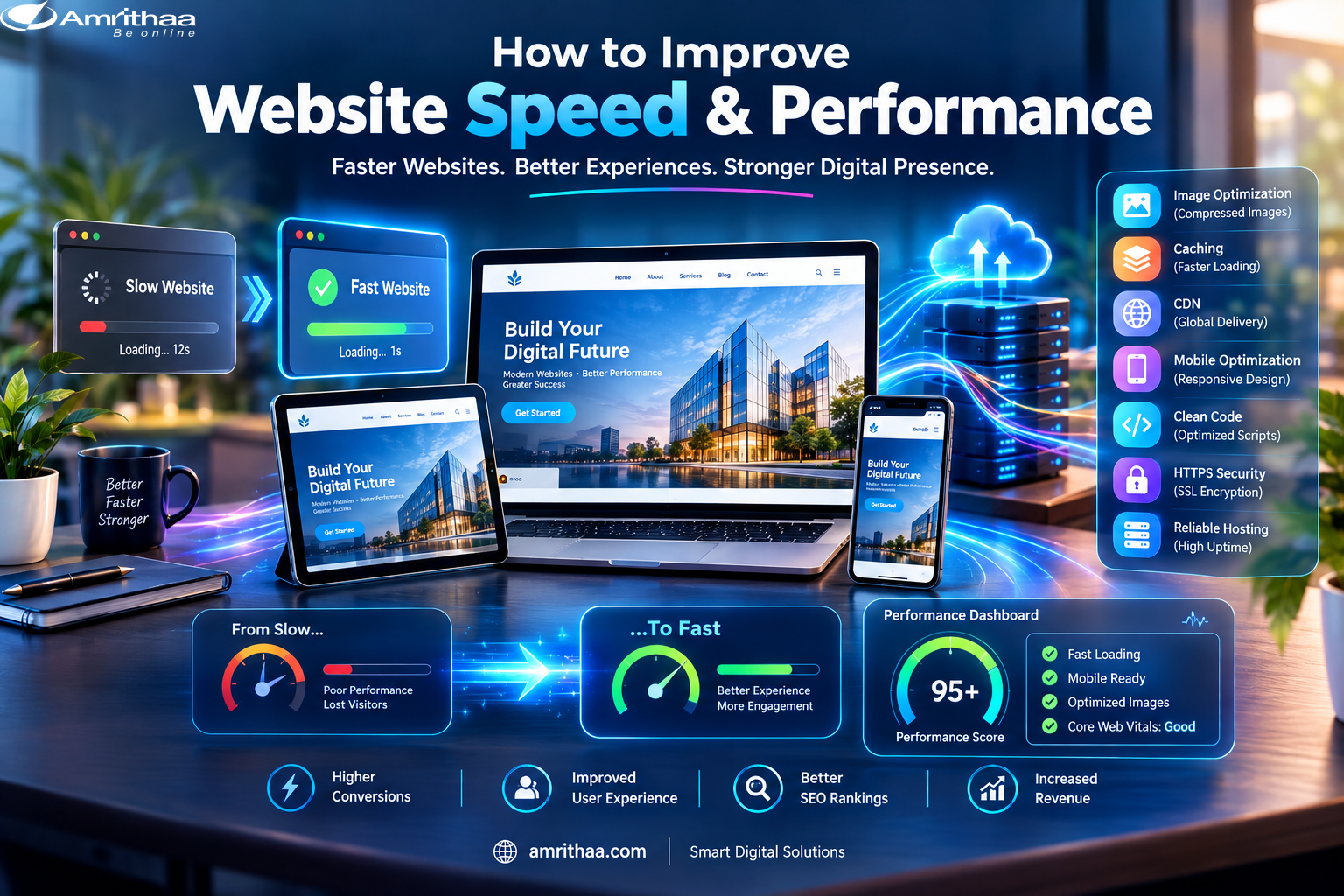
In today’s digital world, visitors expect websites to load quickly and work smoothly. When a webpage takes too long to load, visitors may leave before seeing the content, products, or services. This can affect user experience, engagement, and business opportunities.
Website speed and performance are therefore important parts of building a successful online presence. A fast website helps visitors access information quickly, navigate easily, and complete actions such as submitting an enquiry or purchasing a product.
So, how can you improve website speed and performance? Let’s explore some practical methods.
Website speed is more than just a technical measurement. It directly affects how visitors interact with your website.
A slow website can make users frustrated, especially when browsing on mobile devices or slower internet connections. On the other hand, a fast website creates a smoother browsing experience.
Website performance can also support SEO because search engines consider page experience and performance-related signals when evaluating websites.
For businesses, improving speed can help create a better first impression and make the website more effective as a digital marketing and sales channel.
Large and unoptimized images are one of the common causes of slow-loading websites.
High-resolution images are useful for visual quality, but uploading unnecessarily large files can increase page size and loading time.
To improve image performance:
For example, a large banner image does not always need to be several megabytes in size. Proper optimization can significantly reduce the amount of data a visitor needs to download.
Caching allows commonly requested website resources to be stored temporarily so they can be delivered faster on subsequent visits.
WordPress websites can benefit from suitable caching solutions that optimize page delivery, browser caching, CSS, JavaScript, and other resources.
A Content Delivery Network (CDN) can also help distribute static website resources through servers located closer to visitors.
The combination of effective caching, optimized resources, and suitable hosting can improve website responsiveness.
Adding too many plugins, scripts, animations, tracking tools, or third-party resources can increase website loading time.
This does not mean every plugin should be removed. Instead, regularly review your website and identify tools that are unnecessary, outdated, duplicated, or no longer being used.
For WordPress websites, keep themes and plugins updated and remove unused plugins rather than simply leaving them inactive.
You can also reduce unnecessary CSS and JavaScript where possible and avoid loading resources on pages where they are not required.
For businesses developing or improving their online presence, amrithaa.com focuses on modern website solutions with performance, responsive design, and business requirements in mind.
Your hosting environment can have a significant impact on website performance.
A website with optimized images and clean code can still perform poorly if the server is slow or poorly configured.
When choosing hosting, consider factors such as:
As website traffic increases, businesses may also need to review their hosting resources and upgrade their infrastructure when necessary.
Many visitors access websites using smartphones. A website should therefore perform well on both desktop and mobile devices.
Mobile optimization includes more than simply making a website responsive. Pay attention to image sizes, font loading, buttons, navigation, scripts, pop-ups, and page layout.
Test important pages on different screen sizes and network conditions to understand the real user experience.
Tools such as Google PageSpeed Insights can help identify performance opportunities and provide technical recommendations.
Website optimization should not be a one-time activity.
Adding a new plugin, uploading large images, installing tracking scripts, changing a theme, or adding new features can affect performance.
Regularly monitor important pages and check for:
Keeping track of performance allows businesses to identify issues before they significantly affect visitors.
How to improve website speed and performance? Start with the fundamentals: optimize images, use caching, reduce unnecessary resources, choose reliable hosting, improve mobile performance, and regularly monitor your website.
A fast website provides visitors with a smoother experience and creates a stronger foundation for SEO, marketing, and online business growth.
Website performance should be considered from the beginning of the development process rather than treated as an afterthought. With regular optimization and monitoring, businesses can maintain a website that is faster, more efficient, and easier to use.
For professional website development and digital solutions, explore amrithaa.com and discover ways to build a stronger digital presence.
👉 Visit amrithaa.com and take the next step toward a faster, better-performing website.