Have you published your website, created service pages, and written blog posts but still struggle to appear on Google? You are not alone. Many businesses invest time and money in their websites but find it difficult to attract organic traffic.
A website does not automatically rank well simply because it is online. Google needs to discover your pages, understand their content, and determine whether they are relevant and useful to people searching for information.
If your website is not ranking on Google, several SEO problems could be affecting its visibility. Understanding these issues is the first step toward improving your search performance and attracting potential customers.
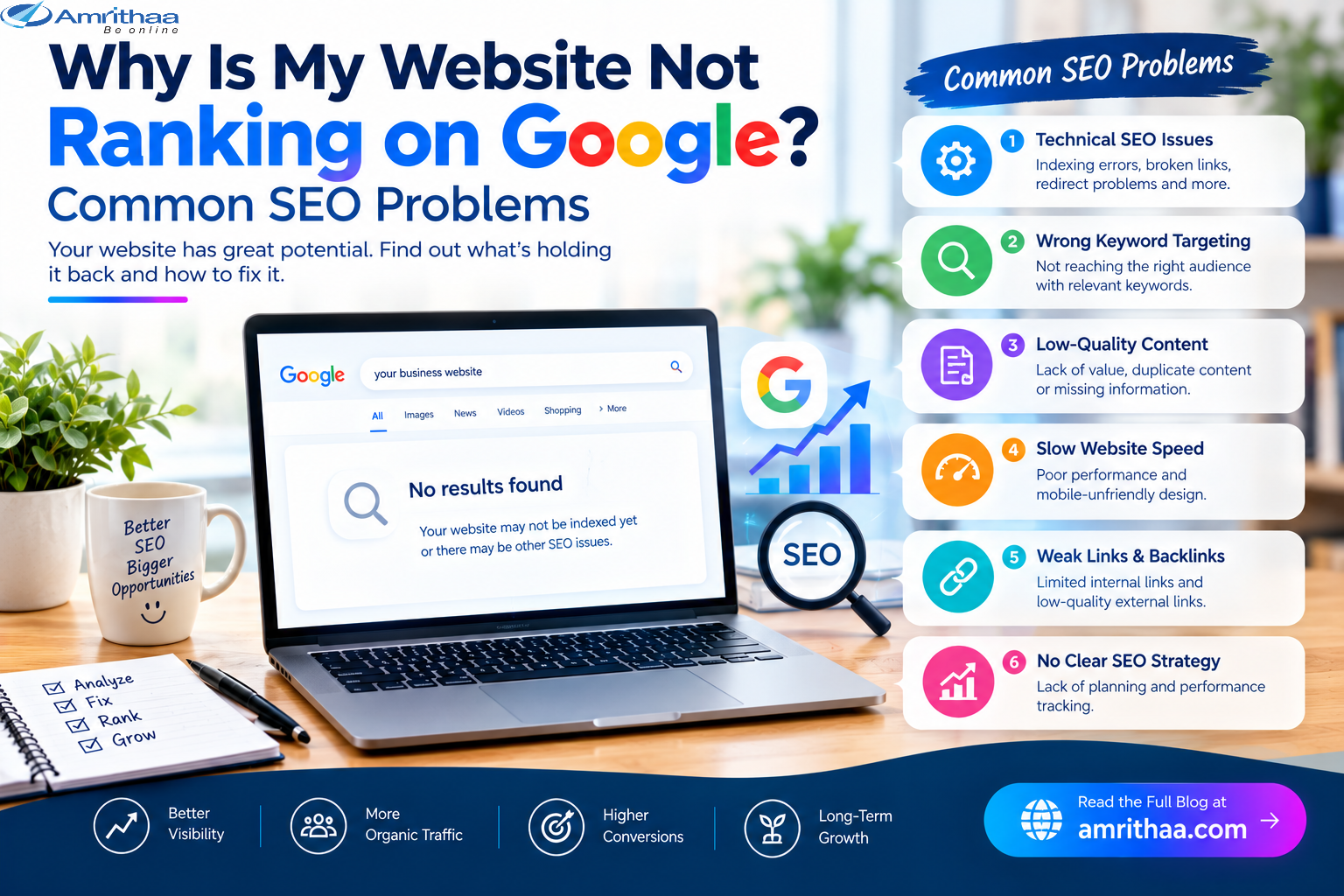
Technical SEO helps search engines discover, crawl, and index your website pages. If Google cannot properly access or index important pages, they may not appear in search results.
Common technical SEO problems include incorrect noindex settings, blocked pages in robots.txt, broken links, redirect errors, duplicate URLs, and missing XML sitemaps.
Start by checking your website in Google Search Console. The URL Inspection tool can help you understand whether a particular page is indexed and identify certain crawling or indexing issues.
You should also submit your XML sitemap and review any reported indexing problems.
Remember that submitting a sitemap does not guarantee indexing or rankings. Your pages must also meet Google’s technical and quality requirements.
Keyword research helps you understand what your potential customers are searching for.
If your website content does not match the search terms and needs of your audience, it may struggle to attract relevant organic traffic.
For example, a business offering website development should create clear service pages that explain its services, benefits, process, and target customers.
Research relevant keywords and use them naturally in page titles, headings, descriptions, URLs, and content. Avoid repeating keywords excessively because keyword stuffing can harm the user experience and violate Google’s spam policies.
Consider search intent as well. Someone searching for information needs a different page from someone ready to hire a service provider.
Create content that directly answers the searcher’s question and provides useful next steps.
Content quality is an important part of SEO. Pages that provide little useful information, repeat existing content, or fail to answer visitors’ questions may struggle to perform well.
Review your important website pages and ask:
Improve weak pages by adding practical information, relevant examples, helpful FAQs, and clear explanations of your services.
Publishing more content is not always the answer. Improving the usefulness of your existing pages may be a better starting point.
At amrithaa.com, businesses can explore digital solutions and website development services that support a stronger online presence.
Website performance can influence user experience and contribute to search performance. A slow, difficult-to-use website may discourage visitors from exploring your services.
Common problems include oversized images, excessive scripts, unnecessary plugins, poor hosting performance, and layouts that do not adapt well to smaller screens.
To improve performance, compress images, enable suitable caching, reduce unnecessary scripts, and choose reliable hosting. Test important pages on both mobile and desktop devices.
You can use Google PageSpeed Insights to identify performance opportunities and Google Search Console to review Core Web Vitals data where available.
Focus on creating a fast, accessible, and user-friendly experience rather than chasing a perfect performance score.
Links help search engines discover pages and understand relationships between content.
Internal links connect relevant pages within your website. For example, a blog about SEO can link to a related digital marketing service page. This helps visitors explore related information and makes important pages easier to discover.
Backlinks are links from other websites to yours. Relevant, trustworthy backlinks can help establish your site’s authority and may also bring referral traffic.
You can encourage natural backlinks by publishing original research, useful guides, case studies, and resources that other websites may find valuable.
Avoid buying spammy links or participating in manipulative link schemes. Focus on relevance, quality, and genuine relationships.
SEO works best when it follows a consistent plan. Randomly publishing blog posts or changing keywords without reviewing performance can make it difficult to identify what is working.
Create a strategy around your main services, target audience, and business goals. Organize related topics into useful content groups and link them to relevant service pages.
Optimize important pages first, maintain accurate business information, and review search performance regularly.
Google Search Console can help you identify search queries, impressions, clicks, and indexing issues. Use this information to find pages that receive impressions but have low click-through rates or pages that need better content.
SEO takes time, and improvements do not guarantee specific rankings. Consistent monitoring and refinement help you make better decisions.
If your website is not ranking on Google, the problem may involve technical SEO, keyword targeting, content quality, website speed, links, or a lack of strategic optimization.
Start by checking whether your important pages are indexed. Then review their content, user experience, keyword relevance, and internal linking. Use SEO tools to identify issues and prioritize improvements based on their potential impact.
A well-structured website with useful content and a consistent SEO strategy can improve its chances of attracting relevant organic traffic over time.
Want to improve your website’s search visibility? Visit amrithaa.com to explore professional website development and digital marketing solutions for your business.