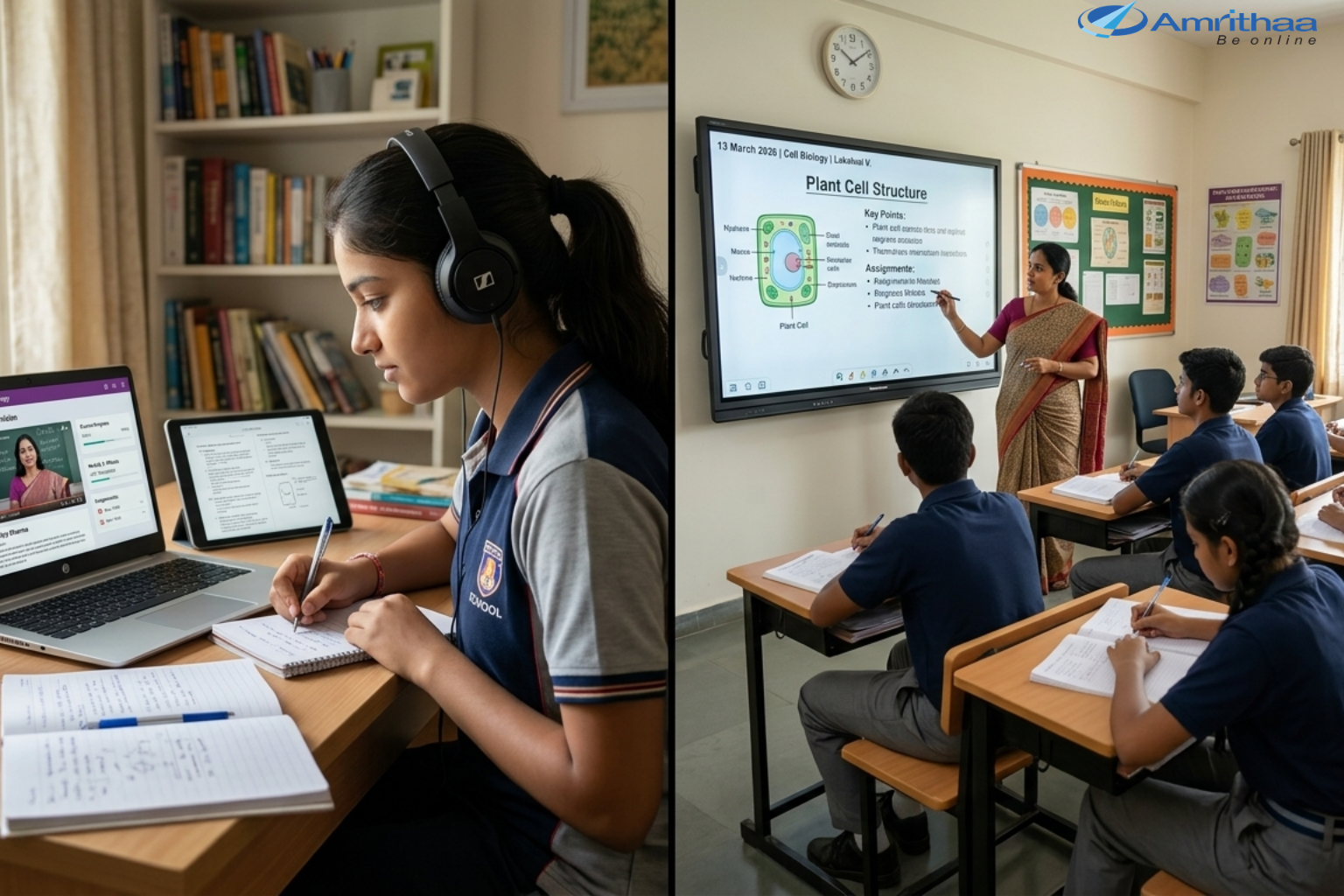
Education has evolved dramatically in the past decade. With the rapid growth of digital technology, learning is no longer limited to traditional classrooms. Today, students can attend classes from anywhere through online platforms, while offline education still offers the benefits of face-to-face interaction.
This has created an important debate: Online vs Offline Learning – which model works best today?
The answer often lies in how effectively institutions combine both methods using modern technology like Educational Mobile App Development and E-Learning Platforms. Digital education solutions developed by amrithaa.com help schools, universities, and training institutes build scalable learning platforms that support both online and offline education models.
Let’s explore how these two learning models compare and how institutions can choose the best approach.
Online learning has gained massive popularity because of its flexibility and accessibility. Students can attend classes from their homes, access recorded lectures, and learn at their own pace.
Some major advantages include:
Educational institutions are increasingly investing in Educational Mobile App Development and Learning Management Systems (LMS) to support online learning.
These platforms allow students to watch video lessons, submit assignments, track progress, and communicate with instructors.
With the right digital infrastructure, platforms built by amrithaa.com enable institutions to create powerful online education ecosystems.
Despite the rise of online education, traditional offline learning still holds significant value.
In physical classrooms, students benefit from:
Subjects such as medical training, engineering labs, and performing arts often require physical presence.
Offline learning also helps develop communication skills, teamwork, and discipline among students.
For this reason, many educational institutions prefer a hybrid learning model that combines the strengths of both approaches.
Hybrid learning combines online digital tools with offline classroom teaching. This model has become the most effective learning approach in modern education.
In a hybrid system:
Educational platforms and mobile apps allow institutions to manage hybrid learning smoothly.
Features of hybrid learning systems often include:
With the right technology platform, institutions can scale education while maintaining quality.
Development specialists like amrithaa.com help institutions design custom Education Mobile Apps and Learning Management Systems tailored to their academic structure.
Digital education platforms require advanced technology infrastructure to function smoothly.
Some common components include:
These systems ensure that learning resources remain accessible anytime and anywhere.
Institutions investing in Education Website Development and Educational Mobile App Development can reach a wider audience and expand their learning ecosystem.
Developing a digital education platform involves multiple technical and operational factors. Institutions often begin with an MVP (Minimum Viable Product) before expanding into a full-featured learning system.
A digital education platform usually requires:
The team works together to build a stable and scalable education platform.
An MVP version typically includes core learning features such as:
Launching with an MVP helps institutions test the platform before adding advanced capabilities.
Educational platform development generally follows these stages:
1. Research and Planning
2. UI/UX Design
3. MVP Development
4. Testing and Quality Assurance
5. Launch and Continuous Improvement
Digital education systems must be scalable, secure, and easy to use.
This is where amrithaa.com provides expert consulting helping institutions estimate development costs, plan MVP strategies, and design sustainable business models for digital learning.
Both online and offline learning models offer valuable benefits. Online learning provides flexibility and accessibility, while offline learning encourages direct interaction and structured education.
The most effective approach today is hybrid learning, where institutions combine digital technology with traditional teaching methods.
By investing in Educational Mobile App Development and Digital Learning Platforms, institutions can expand their reach, improve learning experiences, and adapt to modern education trends.
If you’re planning to build a digital learning platform, amrithaa.com offers complete consulting services from cost planning and MVP development to scalable education business models.